Ensure That You Add an Audio Account in My Preferences

One trouble I run into all the fourth dimension is Information technology administrator never beingness able to control who is a local administrator of whatsoever particular computer. The problem is that when you give someone local admin admission to a computer (considering they legitimately demand it) you cant terminate them from giving admin access to someone else on the same computer. When this does happen it is also its near impossible to discover every bit yous have to run a query every computer to see who is in the local admin group so figure out which account should exist a member. Once solution to this is of class following Microsoft all-time exercise and not give your users local admin access to their PC or Server and in an utopian environment this would be possible but we all live in the real globe where managers have admin access to their PC'southward and developers are allowed to install any software they want. And so how do you give a users full admin access to a figurer but stop them from adding more people to the local admin grouping on a calculator? Use Group Policy Preference of course.
But first a flake of History… Since Grouping Polices were first introduced with Windows 2000 there was an setting called "Restricted Groups" which allows you to control the membership of a group. This option had 2 modes one called "Members" option which I also call the "Iron Fist" way and the other "Members Of" option which is much gentler. The "Members" option removes any groups or users that are not explicitly specified and the "Members Of" choice just adds a specific grouping which out removing any existing groups. The "Members" option was really good at cleaning upwards those rogue members of the local admin group but its was also really hard to setup equally you had to accept a new group policy every time you wanted a dissimilar list of members in local grouping on a computer. The "Members Of" option was a lot easier to maintain as you could layer multiple grouping policies on top of each other but this normally resulted in just adding some other layer of group to the pile of groups that were already in the local administrators group. The other problem was the "Members" choice would override the "Members Of" choice so there was really no manner of mixing the 2 modes.
Simply… Grouping Policy Preferences can employ Variables which enabled you to be very extremely granular in controlling you local admin group while still having "Iron Fist" control. Muuhhaaaahahahahah!!!
How do I setup a restricted local administrator group?
The post-obit steps will demand to be applied to a GPO that is practical to the computer objects you desire to control the local ambassador groups. Note: Y'all must brand sure you don't have whatsoever other Grouping Policy "Restricted Groups" settings applied to your computers as they will always override the grouping policy preferences settings.
Pace 1. Open the Group Policy Management Consol and edit the group policy that is practical to the scope of computers that you lot want to control.
Stride two. Become to the Computer Configuration > Preferences > Control Panel Settings > Local User and Groups option (see Epitome one.).
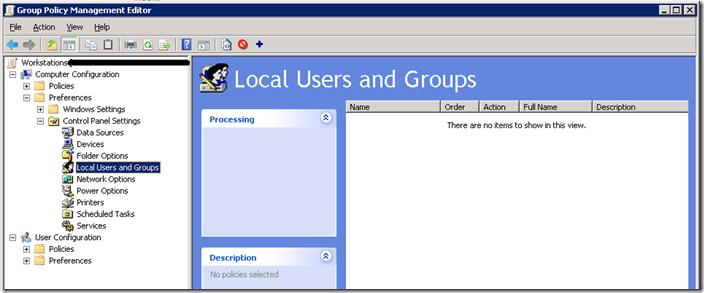
Prototype ane. Local User and Group
Step 3. Now click on Actions > New > Local Grouping
Pace 4. Now yous volition be need to select "Administrators (built-in)" from the group proper name equally this e'er selects the built-in administrators group fifty-fifty if you lot take renamed it to obfuscate the name of the admin account.
Step 5. Tick both "Delete all member users" and "Delete all member groups". These ii options will automatically remove whatsoever users or groups that are not explicitly being added to the group. You merely demand to do this on detail number 1 in the list of settings every bit that setting will be candy final.
Footstep 6. Now you lot will need to make sure you have added back in the Domain Admin's and Local Administrator groups so that you don't totally lock yourself out of the computer. To practice this click the "Add…" button to bring upward the "Local Group Member" dialogue box (see Paradigm 2)
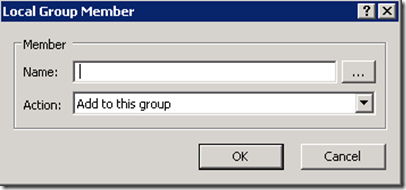
Image 2. Local Group Member
Pace vii. Now type "BuiltIn\Administrator" in the Proper noun field and click OK (see Paradigm 3.)
Notation: The paradigm below is incorrect… it should be "BUILTIN\Administrator"
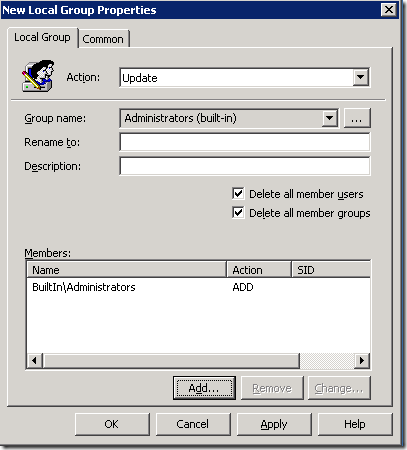
Image 3. Local Administrators group added to the local administrators grouping
Step 8. You lot should also add "DOMAINNAME\Domain Admins" equally it is a skilful practice to have the DA account as a member of the local admin group on all computers in the domain. To exercise this we are going to use the DomainName variables. Click "Add together…" once again and now click in the "Proper name:" text field so press F3. This will now bring up the "Select Variable" dialogue box (See Image 4.). Click on the "DomainName" field and press "Select" and then "OK". (alternatively you could type %DomainName% in the proper name field and merely press OK.)
Note: The image below is too incorrect… The bottom image should be "BUILTIN\Administrator"
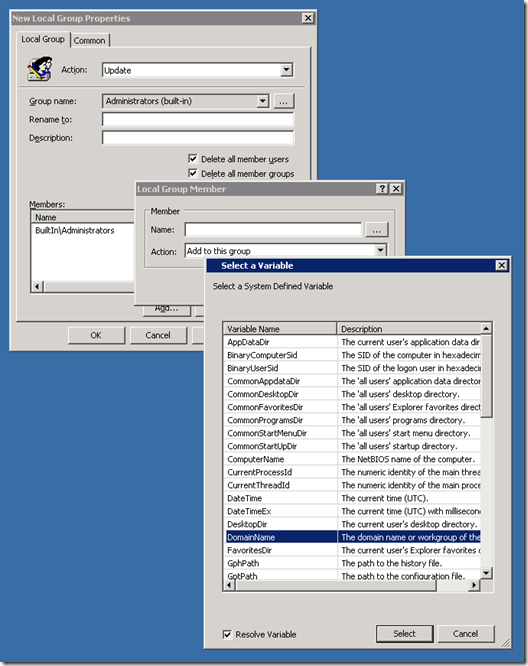
Epitome iv. Selecting the DomainName Variable
You should now see the post-obit which will restrict the local administrator grouping to only accept the Domain Admins and the local administrator.
Annotation: The paradigm below is wrong. Information technology should exist "BUILTIN\Ambassador"
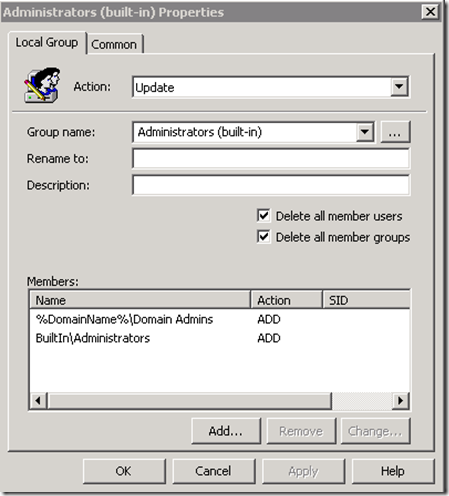
Image 5. Basic local assistants group setting
Then what y'all equally? I tin do this already with the "Restricted Groups" Group Policy setting. Well only having the local Administrator and Domain Admin's in the local admin grouping isnot non much use unless you are willing to give everyone the local admin password or give them all Domain Admin's privileges (Like that e'er happens) when e'er they needed admin access. Well again this is where Group Policy Preferences can aid.
How to add individuals to a unmarried computer?
Now we are going to go thorough how to add a uniquely named domain grouping to the local administrators group without having to set up multiple group policies objects. This scenario is very helpful if yous want to grant a single user or group local administrators access on computer merely however ensure that no other users or groups can be added without explicitly being approved. In the steps below the figurer proper noun is DESKTOP01 and the domain proper name is CONTOSO, we want to add the group "CONTOSO\DESKTOP01 Administrators" to the local ambassador group only we also want the same to happen on DESKTOP02, DESKTOP03 and and then on, each with their own uniquely named group based on the computer name.
Update: Having a unique group for each computer allows you lot to easily grant permission to for a single users to a unmarried computer as there is a one to one mapping of domain groups to local administrator groups.
Footstep 9. At present go dorsum and repeat steps 3 to vi until you get to the Local Group Fellow member dialogue box again (see Image half dozen.).
Annotation: This creates a second local administrator group entry in the listing to work around an effect.
Image half-dozen. Add Local Group Member
Step 10. Type "%DomainName%\%ComputerName% Administrators" in the Name text field and click "OK" (Image seven.)
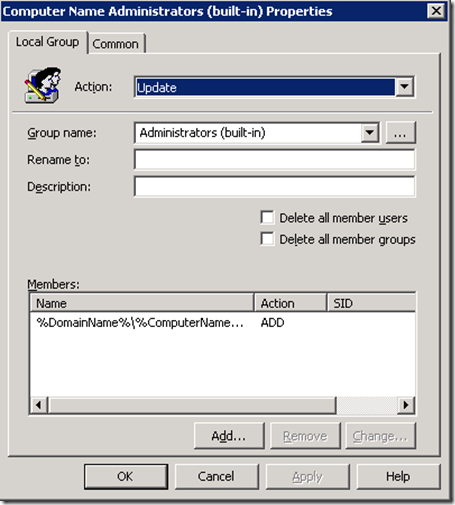
Image 7. Configuration to automatically unique group to local administrators grouping
Now this volition now automatically add a domain grouping called "DOMAINNAME\COMPUTERNAME Administrators" to the local administrators group on the estimator to which the policy is applied and your group policy should look like Epitome viii.
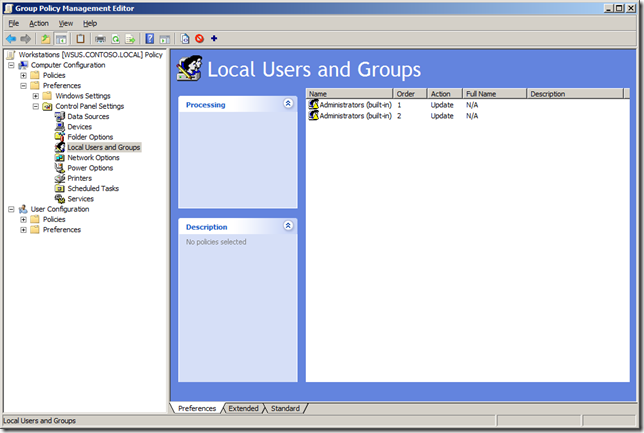
Image 8. Two local administrator grouping settings
Update: There are ii separate local administrator group setting in the policy, the beginning one is the setting yous see in image five and second one is the setting you can see in image 7.
However the "CONTOSO\DESKTOP01 Administrators" group volition only be added to the local administrators grouping on the computer DESKTOP01 if that group is already exists. Therefore you do not demand to create the grouping until the need arises to add an individual user or group to just a unmarried figurer.
Update: This policy will not create the group in your Active Directory called "DOMAINNAME\COMPUTERNAME Administrators" and you lot don't have to create information technology unless you desire to use it to grant permission to the reckoner. Once you accept created the group yous can and then add a single user to the domain group… or multiple user accounts and groups. The other reward of having this domain group is that it is the only identify where you tin grant admin admission to the calculator without it being automatically removed there fore it makes auditing who is a local administrator on a workstation much easier every bit you lot but have to audit the domain groups. This ways that you lot tin can fifty-fifty report on who has admission to the reckoner when the calculator isn't fifty-fifty connected to the domain.
This grouping policy setting combined with the other setting made earlier (see Prototype 5.) will mean that the local administrator group on the calculator DESKTOP01 in the CONTOSO domain volition have the post-obit members automatically added to the grouping:
- CONTOSO\Domain Admins
- DESKTOP01\Administrator
- CONTOSO\DESKTOP01 Administrators
But ANY other users or groups volition be automatically removed after the next grouping policy refresh. This does mean there is a slight window of opportunity for someone to slip in an united nations-authorised account into the local administrators grouping but they will go removed at the next policy update.
Side Note: I have institute that users almost never mutter that they cant add together un-authorised user to the local admin account on computer. Go figure… 🙂
AWSOME!!!! I hear you say… but expect in that location is more…
How practise I add boosted broader groups to the local administrators group?
Now that y'all are able to granuarlly add together a single user or group to the local administrators grouping on a computer you lot might run across problems id you accept more than a 1000 computers due to AD Token Bloat Issues . So to get around this we tin can setup some more broadly applied ambassador groups to the calculator that volition give admin access to only a subset of computers such as all workstations or only the SQL Servers in your organisation.
Workstations Admin Groups
To employ a Workstation administrators grouping to the local administrators group on all workstations make sure you take a group policy just targeted to your workstations. This is unremarkably pretty piece of cake as almost companies isolate their workstations computer accounts to one (or a select) number of Organisational Unit of measurement.
Pace xi. Go back and echo steps half dozen and 7 only this fourth dimension add the group "%DomainName%"\Workstations Administrators" in the name field. This will added the additional group "CONTOSO\Workstation Administrators" to the local admin group on all the workstations in your domain which volition allow yous to easily add together all the Desktop Administrators in your organisation access to all the workstations without having to give them the local admin password or domain admin's privileges.
Server Function Admin Groups
Information technology gets a little tricker when you lot want to grant access to a server based on its function as server are sometime configured for multiple roles. Then in these steps we are going to automatically added a domain group chosen "CONTOSO\SQL Server Administrators" to all the servers y'all have that take SQL Server installed on them. This will be very handy to making sure SQL service accounts or database administrators have admin access to all the servers that have Microsoft SQL Server installed. You lot can however brand multiple version of these admin group for other roles (eastward.one thousand. Commutation,SCCM,ISA) y'all just demand to know what the best style to target the setting.
Step 12. First brand sure you are editing a grouping policy that is applied to all your servers in your arrangement.
Stride thirteen. Repeat Step 9 and 10 and so we open the properties of the new policy setting and specify the grouping only this fourth dimension nosotros type "%DomainName%\SQL Server Administrators" in the proper noun field.
Step 14. Click on the "Common" tab and then tick "Item Level Targeting" and click the "Targeting…" button.
Pace fifteen. Click on the "New Particular" in the carte du jour bar and select the option you want to use to target all the SQL servers in your organisation and select the "File Match" option to await in the Programme Files folder and see if a sub-binder exists called "Microsoft SQL Servers" (See Epitome 8). This is normally true for any server that has Microsoft SQL Server installed and so it will and then automatically apply the SQL Server Admin group to that server if it was installed.
Note: In this example we tested that the "Microsoft SQL Server" binder exists just nosotros could likewise make rule to examination for the existence of a particular file or registry key.

Epitome eight. Testing to come across if Microsoft SQL Server is installed.
Now whatsoever figurer that SQL Server, MSDE or SQL Express installed will get the group "CONTOSO\SQL Server Administrators" automatically added to the local admin group.
This squeamish thing about this is that if SQL is installed on the server at some point in the future the SQL Admin group volition be added automatically at the next group policy refresh without you having to do a thing.
Finally.. at present you have tight control of the local administrator groups on all the computers in your domain information technology is now important to monitor and secure the domain groups that are being added to the local administrator groups every bit they now control who has admin access to all your computers. Simply I volition save how to do that for another blog post…
Source: https://www.grouppolicy.biz/2010/01/how-to-use-group-policy-preferences-to-secure-local-administrator-groups/

Post a Comment for "Ensure That You Add an Audio Account in My Preferences"