What Does a Blue Bbonnet Look Like Through All Stages
Bluebells and Bluebonnets: The Flower(s) of Scotland and Texas
Blue is my favorite colour, cobalt blue especially, which falls more toward the violet end of the blue spectrum. And I am not alone. According to Wikipedia, "Surveys in the US and Europe show that blue is the colour most commonly associated with harmony, faithfulness, confidence, distance, infinity, the imagination, cold, and sometimes with sadness. In US and European public opinion polls it is overwhelmingly the most popular colour, chosen by almost half of both men and women as their favourite colour."
From March to September, acres and acres of both Scotland and Texas are carpeted in blue, with the blooming of Scottish Bluebells and Texas Bluebonnets. This shared artistry of Mother Nature is just one of many commonalities that I continue to discover and explore between my native homeland of Texas, and my ancestral homeland, Scotland.
As wildflowers go, both Bluebells and Bluebonnets enjoy almost fanatical followings, perhaps because of the popularity of their colour? In both Scotland and Texas, people will travel many miles to photograph, picnic, or just walk among these natural carpets of colour. These delicate blooming perennials have also inspired artists through the ages; the Bluebell in Scotland (Hyacinthoides non-scripta) having first been identified in 1753 and often associated with ancient woodlands or "Bluebell woods." The Bluebonnet in Texas dates to a time before there was a "Texas" when the region was home to native American Indians, and likely before.
A carpet of Bluebonnets is a "floral trademark" of Texas in Springtime!
The British or Common Bluebell favors woodland floors and "bluebell woods" are hugely popular in Springtime. Photo credit: Bluebell wood at Kinclaven in Perthshire by David Mould. www.davidmould.co.uk
Click each image to enlarge. Bluebonnet photo by author, Bluebell photo by David Mould.
Controversy
In Texas, the Bluebonnet is the official state flower (all 5 varieties), having been proclaimed such by the state legislature originally in 1901. At that time the National Society of Colonial Dames of America put forth Lupinus subcarnosus (generally known as buffalo clover or bluebonnet) and it won easily against its competition, the cotton boll and the cactus. That's when the battle began, and it raged for 70 years! Lupinus subcarnosus is a dainty flower that is found mostly in coastal and southern regions of the Lone Star State. Many felt the bolder, heartier, showier Lupinus texensis should have won the honor. For years a polite argument ensued and politicians, as they often do, deferred any decision less they offend one group or the other. Finally, 1971 saw a political compromise when the legislature named both varieties the state flower, along with (in a stroke of political genius!) "any other variety of bluebonnet not heretofore recorded." Today, there are 5 identified varieties, so Texas has 5 "state flowers."
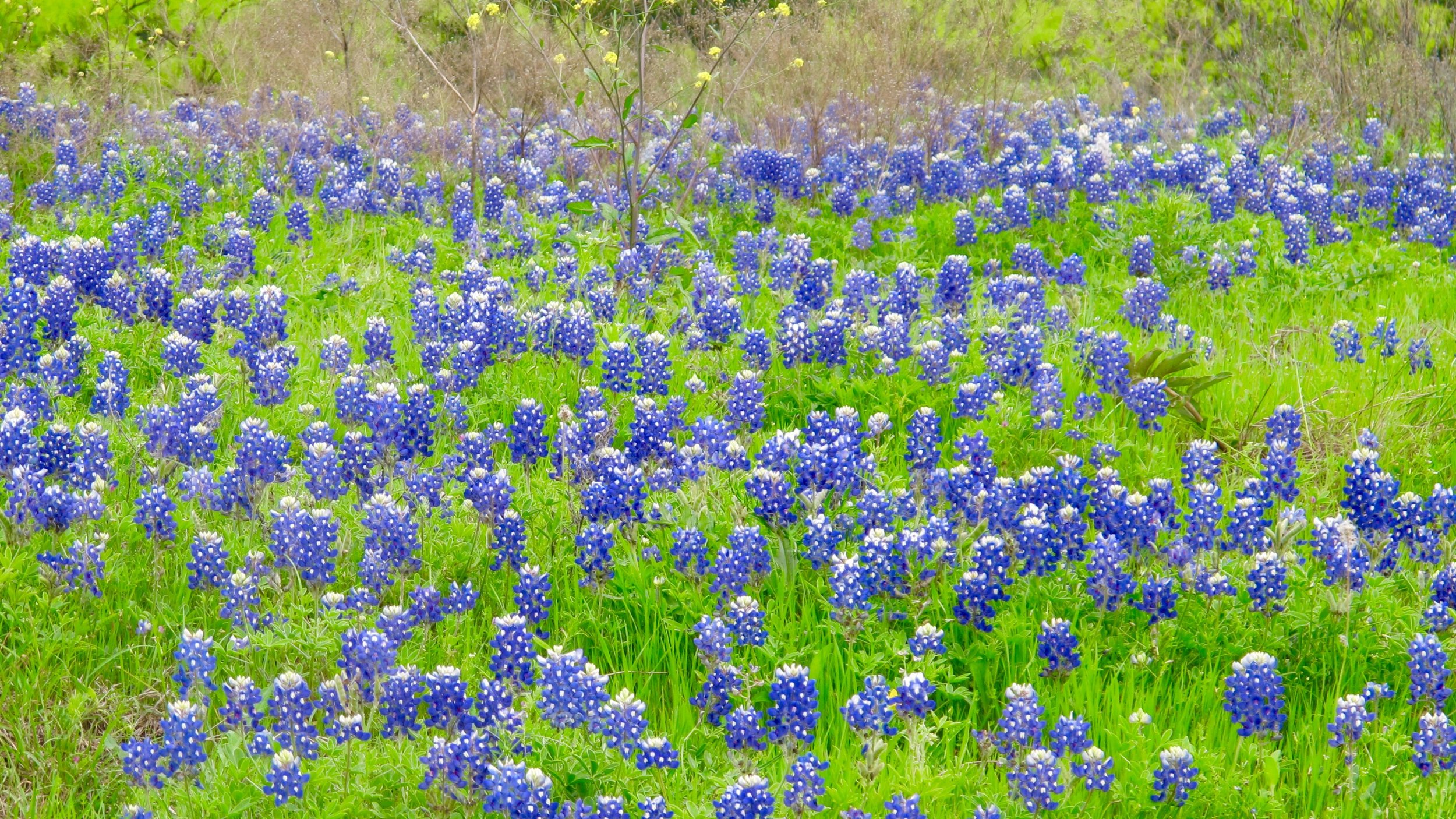
Lupinus Texensis is the most common bluebonnet variety and is considered by most as THE Texas Bluebonnet. Note the distinctive white "bunny tail" that tops the blooms.
In Scotland there is an equally confusing yet polite controversy surrounding the "Bluebell."
Hyacinthoides non-scripta is found from northwestern Spain to the British Isles (including throughout primarily eastern Scotland). It is known as the British Bluebell or English Bluebell or common bluebell or simply "bluebell" and as Wild Hyacinth. Like the Texas Bluebonnet, the Common Bluebell blooms in Spring, typically mid-March into May. While it does not enjoy "official" status like the Texas Bluebonnet, UK law protects it. The Wildlife and Countryside Act of 1981 prohibits landowners from removing common bluebells from their land for sale, and it is a criminal offense to remove the bulbs of wild common bluebells. Any trade in wild bluebell bulbs or seeds can lead to fines of up to £5,000 per bulb. Och no! Och aye!
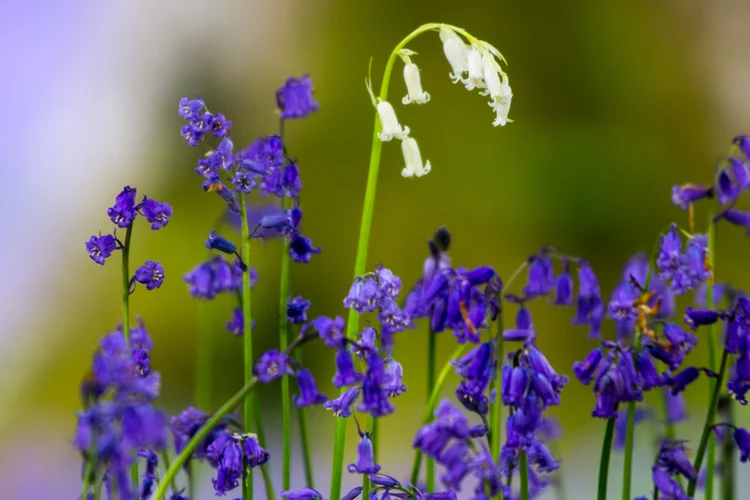
Photo credit: David Mould. www.davidmould.co.uk
But in Scotland a "Bluebell" is not necessarily a "Bluebell." In Scotland it is quite the common practice to apply the term "bluebell" to another flower, the Campanula rotundifolia, also known as the "Harebell."
Where the common bluebell is given to woodland floors, the harebell is more of a meadow flower, found in nutrient poor grasslands, or making its home in the cracks of cliff faces or dunes. (Not unlike the daintier variety of the Texas Bluebonnet.) Its pale to violet-blue flowers have 4, 6, or 7 petals fused into a bell shape, but they lack the distinctive reverse curving tips so distinctive of the common bluebell. Unlike the bluebonnet and bluebell, the harebell is a summer flower, blooming from July well into September.
The British or Common Bluebell blooms in spring and is the flower associated with "bluebell woods." Note the reverse curving tips of the blooms. Photo Credit: By MichaelMaggs (Own work) [CC BY-SA 3.0 (http://creativecommons.org/licenses/by-sa/3.0)], via Wikimedia Commons
Campanula rotundifolia, or harebell commonly known as the Scottish Bluebell. Note the outward curving petals. Photo credit
Click on each image to enlarge
So which is the true "Scottish" bluebell? I posed that question in a purely unscientific poll to a 50,000+ FB group of Scottish photographers. The British, or common, bluebell achieved victory by a count of about 2-1. However, those who favored the Harebell were adamant this was THE Scottish Bluebell, the other being an interloper from the south. (Ahh, politics!) One respondent, who likely has a future as a Texas politician, put it this way. "The English have Bluebells in spring and Harebells in summer.. The Scots have Bluebells in spring and summer !!!!!"
Lore of the Blooms
Along with their vibrant blue color, bluebells and bluebonnets are steeped in folklore and legend. For example, there are a number of American Indian tales of how the bluebonnet got its name. One recounts how those warriors who had gone on to the happy hunting grounds fought a mighty battle, tearing chunks from the blue sky. These pieces of sky fell to earth and shattered into many pieces becoming the blooms of the bluebonnets. Another story suggests they were named for a resemblance to the bonnets worn by pioneer women. It's even been suggested they were named for the bonny blue bonnets (tam o' shanter) favored by Scottish Texicans, but the bluebonnet pre-dated even the earliest Scot settlers in Texas. (Before winning its independence, settlers in Texas were called "Texicans" - a cross between Texan and Mexican.)
Bluebonnets were called "buffalo clover" into the 19th century thanks to the false belief that buffalo liked them. Fact is while sheep and goats love them, cattle avoid them and deer will eat them only when nothing else more appetizing is available.
The harebell or Scottish Bluebell is also wrapped in magic. This Scot favorite is often found in meadows favored by hares and many believe the name harebell was derived from this. The magic part comes from a belief that witches could turn themselves into hares and hide among them.
Another, dare I say, more romantic name associated with bluebells in general is "Fairies' Thimbles," because it is widely believed that fairies live among them. To call fairies to a gathering, the bells are rung!

The harebell, or Scottish Bluebell, unlike the common bluebell, prefers grasslands and meadows rather than the floors of ancient woodlands. Photo credit: © Ievgeniia | Dreamstime.com - Field Of Harebell In The Springtime Photo Note: In Finland they are called "Cat's Bell."
The Spanish Connection
Today there is growing concern that both the British and Scottish Bluebell is being overrun by a Spanish variety, H. Hispanica that has been introduced into the UK, also leading to hybrids. In our poll of photographers, few, emm none, had anything nice to say about the Spanish Bluebell!
Ironically, it was once believed that Texas Bluebonnets had been brought to the territory by Spanish padres. This was thanks to their practice of gathering the seeds and planting them around their missions. However, the two primary varieties of bluebonnets are found only in the state of Texas, and nowhere else in the world.
Revered Status
Whether bluebells or bluebonnets, these flowers enjoy widespread popularity, indeed almost a revered, iconic status in their respective lands. In Scotland, the 2006 Scottish Biodiversity List Project, in a survey of Scots seeking to identify flora, fauna, and habitats important to the country, found the harebell (bluebell) at Number 3! (Heather was #1 and the Scots Pine #2; the Thistle was #5).
In Texas, not surprisingly, the bluebonnet's status comes with a higher level of braggadocio - as historian Jack McGuire called it a "floral trademark" adding, "The bluebonnet is to Texas what the shamrock is to Ireland, the cherry blossom to Japan, the lily to France, the rose to England and the tulip to Holland."
Perhaps he should have added, "and the Bluebell to Scotland!"
Note: Both Scotland and Texas enjoy a wide variety of wildflowers in every shade of the rainbow. I recently made a day trip through east and north central Texas and compiled this 1-minute video - Texas from the Roadside: Wildflowers
Source: https://www.agleninscotland.scot/blog-posts/2017/5/8/bluebells-and-bluebonnets-the-flowers-of-scotland-and-texas

Post a Comment for "What Does a Blue Bbonnet Look Like Through All Stages"